

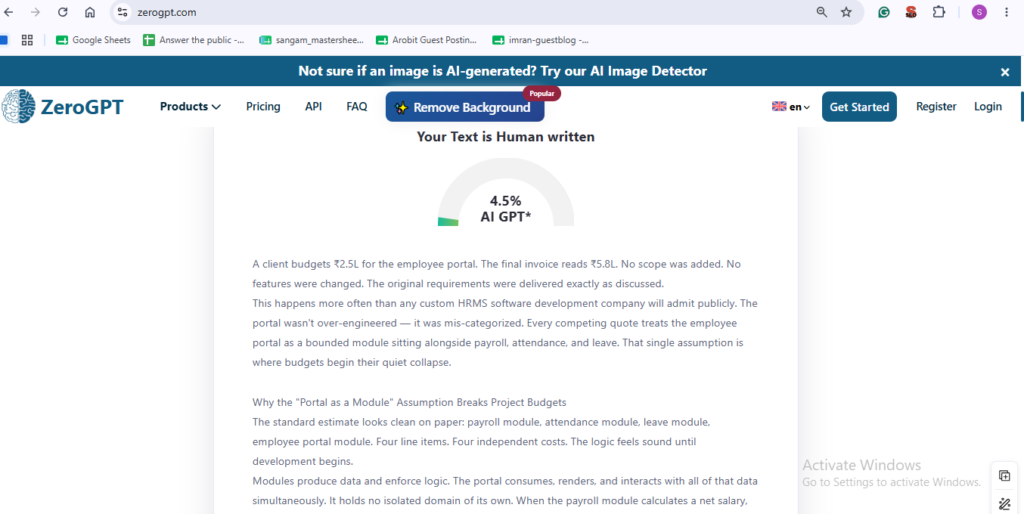
A client budgets ₹2.5L for the employee portal. The final invoice reads ₹5.8L. No scope was added. No features were changed. The original requirements were delivered exactly as discussed.
This happens more often than any custom HRMS software development company will admit publicly. The portal wasn’t over-engineered — it was mis-categorized. Every competing quote treats the employee portal as a bounded module sitting alongside payroll, attendance, and leave. That single assumption is where budgets begin their quiet collapse.
Why the “Portal as a Module” Assumption Breaks Project Budgets
The standard estimate looks clean on paper: payroll module, attendance module, leave module, employee portal module. Four line items. Four independent costs. The logic feels sound until development begins.
Modules produce data and enforce logic. The portal consumes, renders, and interacts with all of that data simultaneously. It holds no isolated domain of its own. When the payroll module calculates a net salary, the portal must display it — securely, correctly, and in compliance with what the payroll engine produced. When the leave module updates a balance, the portal must reflect that state in real time. The portal inherits the complexity of every module it surfaces.
This is not a nuance. It is an architectural reality that flat-line estimates structurally ignore. Projects scoped between ₹8–10L routinely land 40–60% over budget. Across HRMS software development engagements, the portal is the most consistent driver of that overrun — invisible during scoping, expensive during sprints.
The Integration Tax — How Each HRMS Module Inflates Portal Cost
Payroll Module → Portal Cost Implications
Displaying a payslip is not a UI task. It requires server-side PDF generation, dynamic data binding, and version-controlled templates that change whenever payroll logic changes. Salary confidentiality cannot live on the frontend — role-based masking must be enforced at the API layer, baked into every data response. India’s dual tax regime adds another layer: the portal must surface personalized tax computation dynamically, not pull a static figure. Every payroll rule revision triggers a portal re-render, a data contract review, and a full regression test cycle.
Attendance & Leave Modules → Portal Cost Implications
An attendance regularization request is not a form submission. It is a multi-step approval workflow that validates against shift data, checks manager hierarchy, logs an audit trail, and updates the attendance record upon approval. Leave balance displays cannot serve cached data — a stale balance at 9 AM can produce an approved leave that should have been rejected, creating downstream payroll disputes. Comp-off logic, half-day classifications, and dynamic holiday calendars each represent a separate state management problem the portal must resolve in real time.
The portal does not merely display module output. It enforces business logic at the user-facing layer. That distinction is what the industry consistently misprices. Call it the integration tax: a cost that compounds non-linearly with each module added — not additively. Every module interaction introduces new data contracts, new edge cases, and new regression surfaces. When this tax is invisible during scoping, it becomes sprint-by-sprint budget erosion that no contingency line item anticipated.
Where Budgets Actually Break — The 3 Scoping Errors Behind Portal Cost Overruns
Scoping Error 1 — Flat portal estimate regardless of module count. A portal interfacing with five modules is not a scaled version of a two-module portal. Estimation must reflect module surface area: how many data sources does the portal read, how many workflows does it trigger, how many compliance-sensitive displays must it version-control? Flat estimates apply none of this reasoning.
Scoping Error 2 — UI complexity mistaken for total engineering complexity. Clients approve Figma mockups and anchor expectations to visual simplicity. A clean “View Payslip” screen can involve a PDF generation service, a role-permission middleware layer, a payroll data API, an encryption handler, and a compliance-versioning check — five to six backend concerns behind a single button. The interface conceals the architecture entirely.
Scoping Error 3 — No versioning budget for compliance-driven UI changes. India’s statutory environment changes annually. PF ceiling revisions, state-level PT rate updates, and new tax regime modifications each require the portal’s affected displays to be retested, patched, and re-released. This is a recurring operational cost, not a one-time build cost. Teams that omit it do not avoid it — they discover it later, under pressure, mid-cycle.
These are structural scoping errors that occur before development begins. The solution is not a larger contingency buffer — it is a fundamentally different methodology at the architecture stage.
How to Scope the Employee Portal Correctly — The Modular Surface Area Model
Accurate portal scoping begins with a discipline most HRMS software development services skip entirely: mapping every module’s data outputs, approval workflows, and compliance-sensitive displays before a single API contract is written.
Step 1 — Module dependency mapping. For each module in scope, answer three questions: What does the portal read? What does it write back? What approval chains does it trigger? These answers define the portal’s true engineering surface — not the wireframe.
Step 2 — Classify portal components by volatility. Static components (employee profile, org chart) carry low maintenance cost. Compliance-volatile components (payslips, Form 16 previews, tax declarations) require annual review cycles. Workflow-heavy components (leave applications, attendance regularization, reimbursement approvals) require load-tested approval logic. Each tier carries a different long-term cost profile and must be budgeted separately.
Step 3 — Build a portal-specific change management budget. The portal is the user-facing layer of every compliance change made anywhere in the HRMS. When payroll logic changes, the portal changes. When leave policy updates, the portal updates. A standalone maintenance budget for the portal — separate from the broader HRMS maintenance allocation — is non-negotiable for a production-grade system.
Teams applying this model consistently find the employee portal represents 30–40% of total HRMS development effort. Flat-line estimates assume 15–20%. That gap is where project financials break.
What This Means for Your HRMS Investment Decision
Before asking how much a custom HRMS costs, ask a sharper question: how many modules will the portal serve, and how compliance-volatile are they?
Under-budgeting the portal does not reduce project cost — it defers that cost into the most expensive phase possible: mid-sprint rework, post-launch patches, and emergency compliance updates that bypass normal QA cycles. Businesses that approach HRMS software development with portal-first architecture thinking build systems that scale without invoice surprises. The portal is where an HRMS investment either compounds in value — or quietly unravels.
Final Thoughts: Build Your HRMS Portal Like an Architect, Not an Accountant
The employee portal is the most user-visible layer of your entire HRMS investment. Treating it as a flat line item is the single most expensive scoping mistake a business can make. At Arobit, we approach every custom HRMS software development engagement with portal-first architecture thinking — mapping module dependencies, classifying component volatility, and building compliance change budgets before development begins. The result is an HRMS that absorbs statutory updates, scales with headcount, and delivers a portal that performs as precisely as the logic powering it. If your current HRMS quote lists the portal as a simple module, the conversation needs to restart. Talk to Arobit.
Frequently Asked Questions
- Why does adding more HRMS modules increase the employee portal cost even when the portal’s features stay the same?
Each additional module introduces new data contracts, approval workflows, and compliance-sensitive displays the portal must handle. The portal inherits the complexity of every module it surfaces. Adding a fifth module multiplies the integration surface, regression testing scope, and maintenance obligations — not by a fixed amount, but non-linearly. Feature count can stay identical while engineering complexity grows substantially.
- At what project stage do most HRMS portal cost overruns become visible?
Most overruns surface during mid-development sprints, when frontend teams first integrate with backend module APIs. Approved wireframes create false confidence that engineering effort mirrors UI simplicity. The true cost emerges when role-based data masking, real-time state synchronization, and approval chain logic are built — work that was always structurally inevitable, but never appeared in the flat-line portal estimate.
- How should Indian businesses budget for portal maintenance after their HRMS goes live?
Portal maintenance must be a separate, recurring budget line — not an extension of general HRMS support. PF ceiling revisions, state-level PT rate updates, and tax regime changes all require compliance-volatile portal components to be retested and re-released each cycle. A reasonable baseline: allocate 18–22% of the portal’s original development cost annually, exclusively for compliance-driven updates.
- Is an off-the-shelf employee self-service portal a reliable way to reduce integration complexity?
Off-the-shelf portals reduce upfront UI cost but do not eliminate integration complexity — they relocate it. The same data contracts, approval logic, and compliance rendering requirements exist regardless of whether the portal is custom-built or pre-packaged. What pre-built portals typically lack is the configurability to accommodate India-specific compliance rules, organisation-specific approval hierarchies, and module-level data masking. Businesses frequently spend as much adapting an off-the-shelf portal as building a properly scoped custom one.

At Engrnewswire, we are passionate about helping brands grow through smart SEO, GEO, and AEO strategies, supported by High-quality backlinks. With over 2k+ contributor accounts worldwide. We ensure your content reaches the right audience while building lasting authority.