
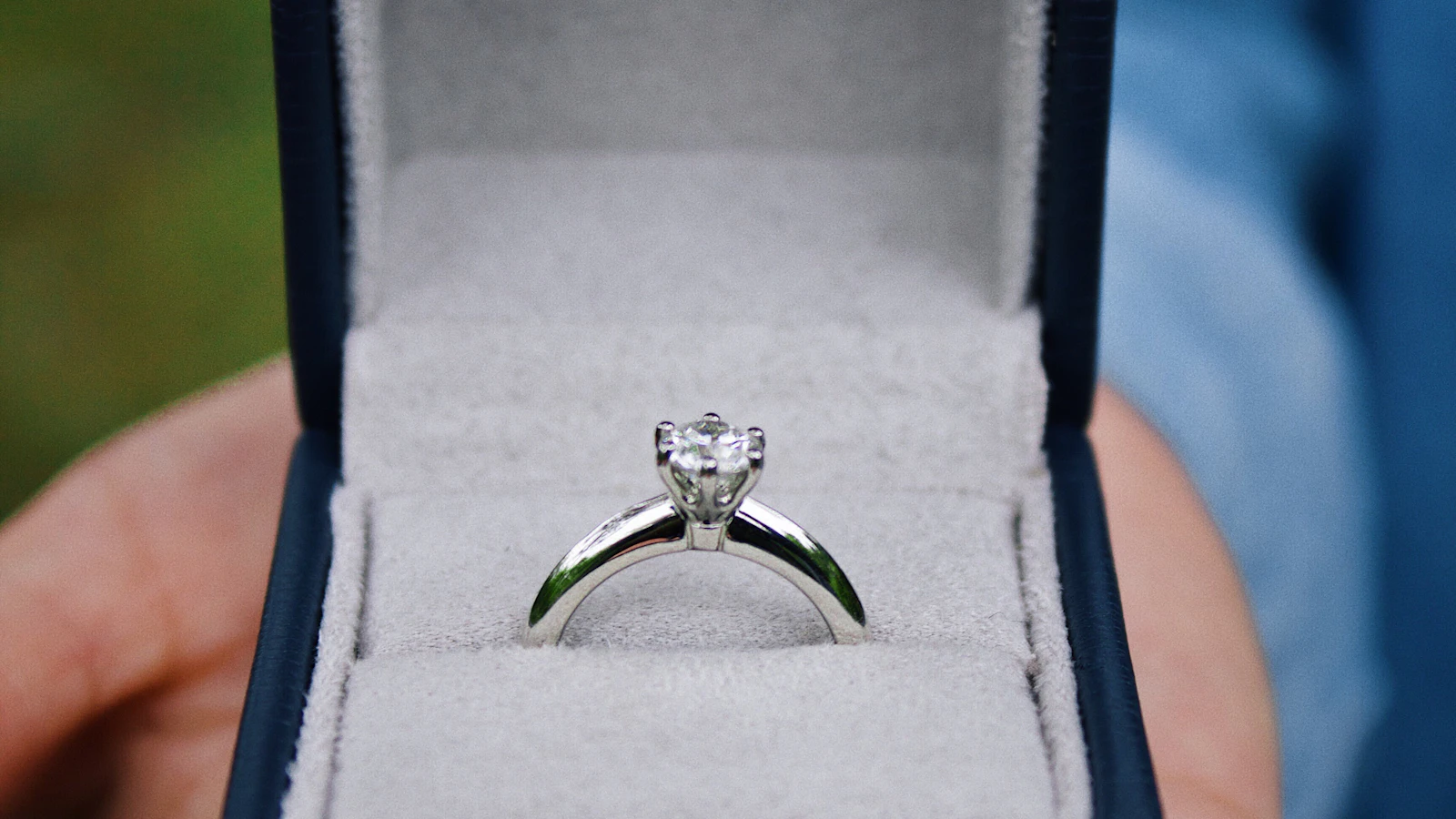
How big is a 1 carat diamond? A well-cut round brilliant measures about 6.4 to 6.5 millimeters across and weighs exactly 200 milligrams, roughly the width of a pencil eraser. That is the short answer, but shape, cut quality and setting all change how large the stone actually looks.
Carat measures weight, not size, so two 1 carat diamonds can look noticeably different. This guide covers sizes by shape, a millimeter chart for round stones, how cut affects the size you see and how to get the most visual impact for your budget.
How big is a 1 carat diamond? The short answer
One carat equals 200 milligrams, or 0.2 grams, and each carat is divided into 100 points. Five carats weigh one gram, which shows how small a single carat really is. For a round diamond with good proportions, that weight translates to a diameter of about 6.4 to 6.5 millimeters when you look down at the top of the stone.
Published size charts vary slightly, with some listing 6.3 millimeters and others 6.5, because every diamond is cut with slightly different proportions. Treat any single number as a guide rather than a guarantee.
Carat is weight, not size
A gem’s size depends on its material as well as its weight, since different materials have different densities. Diamond is less dense than ruby, so a one-carat diamond is physically larger than a one-carat ruby. Within diamonds, a deep or bulging stone can hide weight below the girdle, which adds to the carat number without adding to the face-up size. You can read more about how carat weight is measured and why it differs from size before you shop.
Round diamond size chart in millimeters
These approximate diameters apply to well-cut round brilliant diamonds. Real stones can be a little smaller or larger.
- 0.25 carat: about 4.1 mm
- 0.50 carat: about 5.1 mm
- 0.75 carat: about 5.8 mm
- 1.00 carat: about 6.4 to 6.5 mm
- 1.25 carat: about 6.8 to 6.9 mm
- 1.50 carat: about 7.3 to 7.4 mm
- 2.00 carat: about 8.1 mm
The chart explains a common surprise. Doubling the weight from 1 carat to 2 carats makes the stone only about a quarter wider, from roughly 6.4 millimeters to 8.1. Going from half a carat to one carat adds just over a millimeter of width. Size grows slowly compared with weight.
How cut quality changes the size you see
Cut decides how much of a diamond’s weight shows from above. Two 1 carat stones can differ by half a millimeter or more. One well-known comparison pairs a poorly proportioned 1 carat diamond with a diameter of about 6.2 millimeters against an ideal-cut stone near 6.5 millimeters. Jewelers report that 1 carat round stones can range from roughly 5.6 millimeters for a very deep stone to around 6.6 millimeters for a shallow one.
A shallow cut spreads more width but can lose sparkle, while a deep cut hides weight in the base. The best choice is a balanced cut that shows a healthy diameter and still returns light well. Ask for the measurements on the grading report and compare them rather than relying on the carat number alone.
1 carat diamond size by shape
Shape changes the size you see because weight spreads differently across the stone. The table lists typical face-up measurements for a 1 carat diamond. Fancy shapes are given as length by width.
| Shape | Typical 1 carat size | How it looks |
|---|---|---|
| Round | 6.4 to 6.5 mm across | The standard benchmark |
| Princess | About 5.5 mm square | Often looks smaller than round |
| Cushion | About 6.2 mm | Compact and soft-cornered |
| Oval | About 7.7 to 8 by 5.5 mm | Looks larger than round |
| Pear | About 8.5 to 9 by 5.5 mm | Large face-up area |
| Emerald | About 6.5 to 7 mm long | Long, open top |
| Marquise | About 10 to 10.5 by 5 mm | Largest face-up look |
Measurements differ between sellers and individual stones, so use these as a range and check the exact dimensions of any diamond you are considering.
Why some shapes look bigger
Round brilliants hide much of their weight below the surface, so they do not look the biggest for their carat. Elongated shapes such as marquise, pear, oval and emerald spread more of their weight across the top, which gives them a larger face-up area. Princess, cushion and Asscher shapes tend to look smaller than a round stone of the same weight.
How a 1 carat diamond looks on the hand
A diamond’s look on a finger depends on more than its millimeter size. A slim band and a halo setting make a center stone look bigger, while a thick band makes it look smaller. Elongated shapes can make fingers look longer and slimmer, and a small finger makes the same stone look larger than a long finger does. Always try on several shapes and settings to see how each looks on your own hand.
If you are comparing ring styles beyond the center stone, our guide to what a black wedding ring means covers symbolism, placement and materials for the band itself.
Lab-grown and natural 1 carat diamonds
A lab-grown diamond is made of the same material as a natural one, so a 1 carat stone of either type has the same weight and, with similar proportions, about the same size. Cut quality affects the visible size whatever the diamond’s origin.
How to get more size for your budget
- Consider a stone just under 1 carat. Prices rise sharply at magic sizes like 1.00 carat. A 0.96 carat diamond and a 1.02 carat diamond look almost identical, yet the larger one can cost as much as 20 percent more.
- Check the dimensions on the report. A grading report lists a diamond’s measurements as well as its weight, so you can compare spread between stones.
- Do not trade cut quality for carat weight. A heavier but poorly cut stone can look smaller and dull.
- Look at elongated shapes. Oval, pear and marquise diamonds offer more face-up area per carat.
- Pick a setting that frames the stone. A halo or slim band adds visual size without adding carats.
How to estimate carat weight from measurements
For a round brilliant, multiply the diameter by the diameter by the depth, then multiply by about 0.006 for an approximate carat weight. A stone that measures 6.5 by 6.5 millimeters with a depth of 4.0 millimeters comes out near 1.01 carats. The method is approximate and does not replace a certified weight. For more shopping ideas, browse our Fashion guides.
Frequently asked questions
How many millimeters is a 1 carat diamond?
A well-cut 1 carat round diamond measures about 6.4 to 6.5 millimeters across. Poorly proportioned stones can be smaller, around 6.2 millimeters, while shallow cuts can spread wider. Other shapes are described by length and width, such as about 8 by 5.5 millimeters for an oval.
How much does a 1 carat diamond weigh?
Exactly 200 milligrams, or 0.2 grams. A carat is a unit of weight, and each carat is divided into 100 points. That makes five carats equal to one gram, which shows how little a single carat actually weighs.
Is a 1 carat diamond big enough for an engagement ring?
It is a popular, noticeable size for an engagement ring, especially in a well-cut stone with a slim band or halo. Whether it feels big enough depends on finger size, shape and personal taste, so try several shapes and settings on your hand before you decide.
Which diamond shape looks biggest at 1 carat?
Marquise usually has the largest face-up area per carat, followed by pear and oval. Emerald cuts also look sizable because of their long, open tops. Princess, cushion and Asscher shapes tend to look smaller than a round diamond of the same weight.
Do lab-grown 1 carat diamonds look the same size?
Yes, in practice. A lab-grown diamond is made of the same material as a natural one, so a 1 carat stone weighs the same and, with similar proportions, measures about the same. Cut quality also shapes the visible size, whatever the diamond’s origin.
Does a 0.9 carat diamond look much smaller than 1 carat?
Usually not. A 0.90 carat round diamond is only a few tenths of a millimeter narrower than a 1 carat stone, which is hard to spot by eye. Because prices jump at the 1 carat mark, a slightly smaller diamond can save money with little visible difference.
Conclusion
How big is a 1 carat diamond? A well-cut round stone measures about 6.4 to 6.5 millimeters and weighs 200 milligrams, though shape, cut and setting can make it look smaller or larger. Check the measurements on the grading report, compare shapes on your own hand, and consider a stone just under one carat if you want the same visible size for less.

Sarah Wilson is a versatile writer who covers a wide range of topics, with a strong specialty in entertainment. She delivers engaging, insightful content focused on movies, celebrities, trends, and pop culture.