
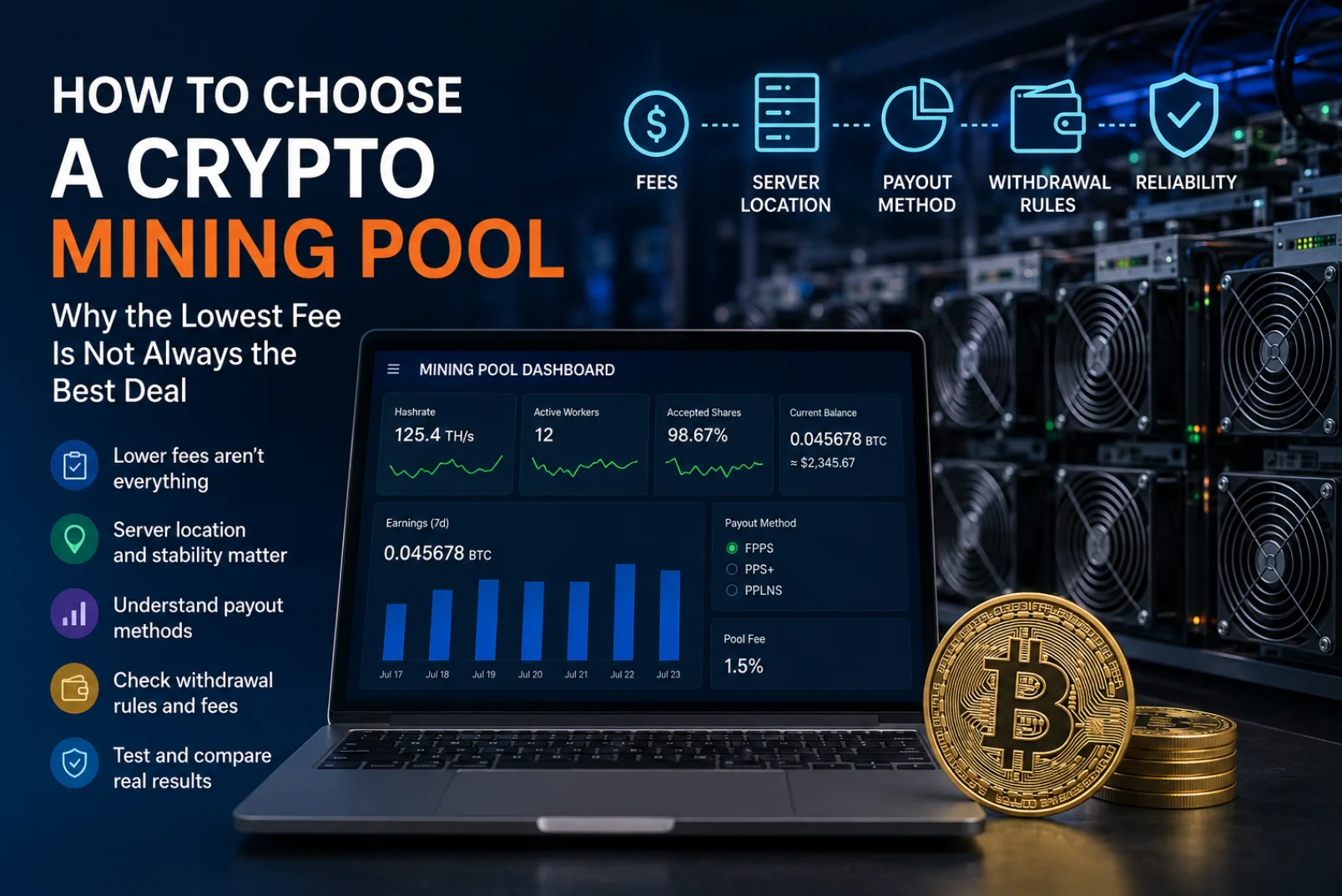
Choosing a crypto mining pool by looking only at its advertised fee is a common and potentially expensive mistake. Platforms such as the EMCD mining pool are better evaluated by comparing net earnings, payout rules, server reliability, withdrawal conditions, and operational transparency rather than focusing on one headline percentage. The right pool is the one that delivers competitive results for your equipment while keeping rejected shares, downtime, payment delays, and other operational risks under control.
A pool charging a 1% fee can produce worse results than one charging more if its servers are poorly located, its payout model does not match your strategy, or its withdrawal requirements leave small balances sitting idle. Miners should therefore compare the complete operating model instead of choosing a service based on a single attractive number.
What a Mining Pool Actually Does
Cryptocurrency mining is based partly on probability. Even powerful mining equipment may operate for a long time without independently finding a valid block. A mining pool combines the computing power of multiple participants, allowing the group to find blocks more regularly and distribute rewards according to the work contributed by each miner.
Pools measure this work through shares. A share usually does not meet the full network difficulty required to create a block, but it proves that a mining device completed a measurable amount of computational work.
When the pool finds a valid block, the operator calculates each participant’s reward using the applicable payout model. The pool therefore affects much more than payment processing. It determines how work is assigned, how contributions are measured, how rewards are calculated, when withdrawals are processed, and what information miners can see about their equipment.
1. Confirm Coin and Hardware Compatibility
The first step is to evaluate the pool based on your mining equipment rather than its marketing claims.
An ASIC miner is generally designed for a specific mining algorithm. SHA-256 equipment can mine compatible cryptocurrencies such as Bitcoin or Bitcoin Cash, while Scrypt, X11, Ethash, and other algorithms require different devices or configurations.
A pool may support multiple cryptocurrencies without supporting the particular algorithm used by your hardware.
Before connecting your equipment, verify:
- The exact cryptocurrency supported by the pool
- The mining algorithm used by that cryptocurrency
- Whether your ASIC, GPU rig, or mining software is compatible
- The required Stratum address and port
- Worker naming requirements
- Whether backup server addresses are available
- Whether merged mining is supported
Entering an incompatible pool address will not make mining equipment support a different algorithm. The hardware, algorithm, coin, and pool configuration must all match.
2. Understand the Payout Method
The payout model determines how mining rewards are calculated and who absorbs short-term mining variance.
Under Pay Per Share systems, miners are compensated according to the valid shares they submit. These methods generally provide more predictable results because the pool operator takes on more of the risk connected with finding blocks.
Full Pay Per Share, commonly known as FPPS, normally includes both the block reward and an estimated share of transaction fees.
PPS+ combines share-based payments with a separate distribution of transaction fees.
Pay Per Last N Shares, or PPLNS, distributes rewards according to a miner’s contribution during a defined share window when the pool actually finds a block. Earnings can fluctuate more noticeably over short periods because the result depends partly on pool luck.
A practical way to compare these models is:
- Choose FPPS or another PPS-based method when predictable cash flow is important.
- Consider PPLNS when you can tolerate short-term fluctuations and intend to mine continuously.
- Check whether transaction fees are included in payouts.
- Review how merged-mining rewards are distributed.
- Confirm whether the payout model differs between supported coins.
The option with the highest theoretical return is not always the best choice for a miner who must cover fixed electricity, hosting, and maintenance costs every month.
3. Calculate the Real Cost
The advertised pool fee is only one part of the total cost of mining.
Miners should also investigate:
- Withdrawal fees
- Minimum payout thresholds
- Currency conversion spreads
- Blockchain transaction fees
- Internal wallet conditions
- Automatic payout requirements
- Additional account or verification restrictions
A low pool fee provides limited value when a small mining operation must wait several months to reach the minimum withdrawal threshold.
Consider this simplified comparison:
| Factor | Pool A | Pool B |
|---|---|---|
| Pool fee | 1% | 2% |
| Rejected shares | 2.5% | 0.4% |
| Withdrawal threshold | High | Low |
| Reporting tools | Basic | Detailed |
| Server stability | Inconsistent | Stable |
Although Pool A advertises the lower fee, Pool B may produce a better net result because more submitted work is accepted and rewards can be withdrawn more efficiently.
The most useful metric is not the published fee. It is the amount that ultimately reaches the miner’s wallet after all costs and losses are considered.
4. Check Server Location and Connection Quality
Mining equipment must communicate continuously with the pool. When the connection is slow or unstable, the device may submit work after the pool has already assigned a new job.
These late submissions may be classified as stale or rejected shares. Because rejected work is normally not rewarded, even a relatively small connectivity issue can reduce effective mining income.
Choose a pool with servers located reasonably close to the physical location of your equipment.
After connecting, monitor:
- Accepted hashrate
- Average hashrate over longer periods
- Rejected share percentage
- Stale share percentage
- Worker disconnections
- Server response time
- Differences between device-side and pool-side hashrate
A small difference between reported hashrate figures is normal because devices and pools may use different averaging periods. A persistent or growing difference requires investigation.
Possible causes include network instability, overheating, hardware errors, incorrect overclocking settings, firmware problems, or a poorly selected pool endpoint.
5. Evaluate Monitoring and Reporting Tools
A useful mining dashboard should show whether each worker is online, how much hashrate it contributes, how many shares are being rejected, and how rewards are calculated.
This is especially important for miners managing several devices or multiple locations. A network interruption, failed fan, incorrect worker name, or disconnected ASIC can quietly reduce earnings when the pool provides no effective warning.
Useful operational features include:
- Individual worker statistics
- Historical hashrate charts
- Configurable offline alerts
- Rejected-share monitoring
- Reward reports
- Fee reports
- Subaccounts for separate locations or clients
- CSV exports
- API access
- Read-only monitoring links
- Mobile or messaging notifications
Transparent reporting does not guarantee profitability. However, poor reporting makes it much harder to identify why profitability is declining.
A miner should be able to reconcile submitted hashrate, accepted shares, pool fees, credited rewards, and completed withdrawals without relying entirely on support staff.
6. Review Payout and Wallet Conditions
Mining rewards may be credited to an internal platform wallet or sent directly to an external cryptocurrency address.
Neither approach is automatically better.
An internal wallet can simplify small payouts, conversions, and account management. An external wallet provides the miner with more direct control after the funds are transferred.
Before connecting significant hashrate, confirm:
- Where rewards are initially credited
- When the balance becomes withdrawable
- The minimum payout amount
- Which blockchain network is used
- Whether automatic withdrawals are available
- Whether withdrawal fees apply
- Whether identity verification is required
- Whether any regional restrictions apply
Always verify both the cryptocurrency and the blockchain network before entering a withdrawal address. Sending assets through an incompatible network may result in a permanent loss of funds.
It is also useful to check whether the pool allows miners to change payout addresses immediately or whether additional security confirmation is required.
7. Examine Account Security
Mining accounts may hold accumulated rewards and provide control over payout addresses. Account security should therefore be treated as an important selection criterion.
Look for features such as:
- Two-factor authentication
- Login notifications
- Withdrawal confirmations
- Address-change restrictions
- Session management
- Device history
- Anti-phishing codes
- Account recovery procedures
A miner should understand what happens if access to the registered email address or authentication device is lost.
Strong security procedures may add a small amount of friction, but they are preferable to a system that allows payout details to be changed without meaningful confirmation.
Avoid reusing passwords from exchanges, email accounts, hosting services, or other mining platforms.
8. Check Pool Reputation and Transparency
A mining pool should clearly explain how it operates.
Before committing equipment, review:
- How long the pool has been active
- Whether payout methods are publicly documented
- Whether fees and thresholds are easy to find
- Whether pool statistics are available
- Whether support channels appear active
- Whether users report unresolved payout problems
- Whether major changes are communicated in advance
- Whether the company or operating entity is identifiable
User reviews can provide useful signals, but they should not be treated as definitive proof.
Mining results naturally vary, especially under payout systems influenced by pool luck. A complaint about one low-reward day is less important than repeated reports of missing withdrawals, unexplained balance adjustments, inaccessible support, or sudden changes in terms.
Compare information from several sources and distinguish technical misunderstandings from consistent operational problems.
9. Test the Pool Before Moving All Your Hashrate
Published profitability calculators provide estimates, but they cannot fully predict real mining results.
Actual earnings depend on:
- Network difficulty
- Cryptocurrency price
- Transaction fee activity
- Pool luck
- Equipment efficiency
- Downtime
- Rejected shares
- Firmware settings
- Electricity costs
A controlled test is more informative than a marketing calculator.
Connect a limited amount of hashrate and monitor performance over a meaningful period.
Record the following metrics:
| Metric | What to Measure |
|---|---|
| Accepted hashrate | Average pool-side hashrate |
| Rejected shares | Percentage of submitted work |
| Net reward | Reward after pool fees |
| Payout method | FPPS, PPS+, PPLNS, or another model |
| Payout timing | Time between earning and receiving funds |
| Downtime | Pool, network, or worker interruptions |
| Support quality | Speed and usefulness of responses |
Normalize the result by hashrate and operating time. For example, compare earnings per terahash per day rather than comparing two wallet balances generated by different equipment.
Avoid evaluating a PPLNS pool after one unusually lucky or unlucky day. Because rewards depend partly on blocks actually found by the pool, a longer observation period is required.
Even predictable PPS-based systems should be compared under similar network, hardware, and electricity conditions.
10. Include Electricity and Equipment Costs
A pool cannot make an inefficient mining operation profitable on its own.
The most important operating cost for most miners is electricity. Hardware efficiency, cooling requirements, hosting fees, repair expenses, and equipment depreciation must also be considered.
A basic profitability calculation can be expressed as:
Net mining profit = mining revenue − electricity costs − pool fees − hosting costs − maintenance costs
To calculate electricity expenses, use the device’s actual power consumption rather than relying only on the manufacturer’s advertised specification.
Power usage may change because of:
- Overclocking
- Underclocking
- Custom firmware
- Cooling conditions
- Power supply efficiency
- Equipment age
- Environmental temperature
For a more accurate comparison, measure power consumption at the wall and calculate the cost using the actual electricity tariff.
A pool that produces slightly higher gross rewards may still be unsuitable if its connection instability causes equipment downtime or requires inefficient operating settings.
11. Consider Support Quality
Technical problems can occur even with a well-managed pool.
A miner may need assistance with:
- Missing worker statistics
- Incorrect payout settings
- Delayed withdrawals
- Account recovery
- Stratum connection errors
- Two-factor authentication
- Reward calculation questions
- Firmware compatibility
Before moving a large amount of hashrate, test the available support channels with a legitimate question.
Evaluate whether the response:
- Arrives within a reasonable period
- Addresses the actual issue
- Provides specific technical information
- Links to relevant documentation
- Explains escalation procedures when needed
Fast but generic replies are not always useful. The quality and accuracy of the response matter more than the initial response time alone.
Mining Pool Warning Signs
A mining pool deserves additional scrutiny when:
- Its fee schedule is difficult to locate
- The payout model is not clearly explained
- Minimum withdrawals are hidden until registration
- The dashboard does not show worker-level data
- Profitability is described as guaranteed
- Support channels appear inactive
- Pool statistics cannot be independently reviewed
- Payout conditions change without notice
- Account security options are limited
- Reported earnings cannot be reconciled with submitted hashrate
- The company provides no clear terms of service
- Users repeatedly report unresolved withdrawal problems
One warning sign does not automatically prove that a service is unreliable. Several unexplained warning signs are a good reason to test another provider.
Common Mistakes When Selecting a Pool
Choosing Only by Fee
A lower fee does not compensate for high rejected shares, weak servers, poor reporting, or inconvenient withdrawal rules.
Ignoring the Payout Model
Comparing rewards without understanding whether the pool uses FPPS, PPS+, or PPLNS may lead to incorrect conclusions.
Testing for Too Little Time
Mining income can fluctuate. A test lasting only several hours may not provide meaningful data.
Moving All Equipment Immediately
A limited test reduces risk and allows miners to identify configuration, connection, and payout problems before moving the entire operation.
Ignoring Minimum Withdrawals
A high threshold can trap small balances or make frequent pool switching inefficient.
Using Only Gross Revenue
Gross rewards do not account for electricity, pool fees, hosting, rejected shares, downtime, and maintenance.
Failing to Configure Backup Pools
Many mining devices allow several pool addresses to be entered. A backup pool can reduce downtime when the primary server becomes unavailable.
A Simple Mining Pool Decision Framework
Before selecting a mining pool, ask five questions.
Does It Support My Hardware and Coin?
Compatibility comes before fees, branding, or additional platform features.
Does the Payout Model Match My Needs?
Predictable share-based payments and variable block-based payments serve different types of miners.
What Will I Receive After All Costs?
Compare net rewards rather than the advertised fee percentage.
Can I Detect Problems Quickly?
Worker monitoring, alerts, regional servers, and detailed reports reduce operational blind spots.
Can I Withdraw Rewards Under Acceptable Conditions?
Review payout thresholds, withdrawal timing, wallet options, security requirements, and regional availability.
The best pool is the one that performs well across all five areas rather than simply winning one comparison.
Frequently Asked Questions
Is a Larger Mining Pool Always More Profitable?
No. A larger pool may find blocks more frequently and provide smoother short-term results, but long-term earnings also depend on fees, payout methods, transaction fee distribution, rejected shares, and reliability.
What Is a Good Rejected-Share Rate?
Lower is generally better, but there is no universal percentage that applies to every algorithm, device, and network environment. Monitor the rate over time and investigate persistent increases or major differences between servers.
Should Beginners Choose PPS or PPLNS?
Beginners who prefer predictable earnings may find FPPS, PPS, or PPS+ easier to manage. PPLNS can suit continuous miners who understand that short-term rewards may fluctuate with pool performance.
Can Miners Change Pools Later?
Yes. Miners can normally change the Stratum addresses in their hardware or mining software. Before switching, check whether unpaid balances exceed the current pool’s withdrawal threshold.
How Long Should a Pool Test Last?
The appropriate test period depends on the payout method and the consistency of the equipment. A longer test is usually more reliable, especially for PPLNS pools where short-term luck can significantly affect results.
Can the Same Mining Device Use Several Pools?
Most mining devices allow a primary pool and one or more backup pools to be configured. Backup pools normally activate when the primary connection fails.
Does a Mining Pool Control the Miner’s Equipment?
The pool provides mining jobs and records submitted work, but it does not normally control the physical device. Miners remain responsible for firmware, power settings, cooling, network access, and hardware maintenance.
Conclusion
Choosing a crypto mining pool is an operational decision, not simply a search for the smallest percentage on a pricing page.
Start with hardware compatibility, understand the payout model, calculate the full cost of receiving rewards, examine server performance, and confirm that the dashboard provides enough information to manage your equipment.
Review payout conditions, security features, reporting tools, company transparency, and support quality before committing significant hashrate.
Finally, test the service using a limited portion of your equipment and compare net earnings under similar conditions.
A reliable mining pool should make revenue more predictable and operations easier to understand. When its terms are unclear or its results cannot be measured, a low advertised fee is not necessarily a bargain. It may simply be an incomplete calculation.

Sarah Wilson is a versatile writer who covers a wide range of topics, with a strong specialty in entertainment. She delivers engaging, insightful content focused on movies, celebrities, trends, and pop culture.