
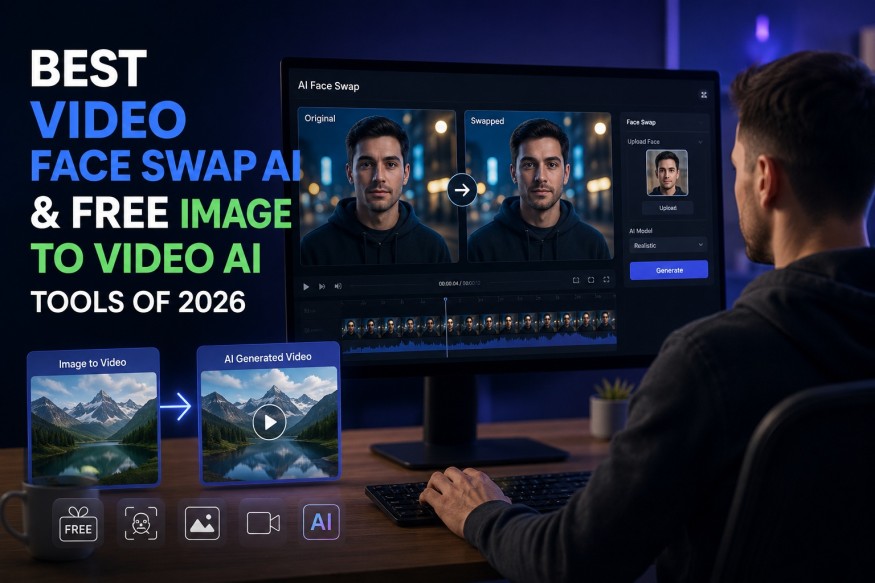
The best video face swap AI and free image to video AI tools of 2026 combine realistic results, simple workflows, and enough creative control for serious content production. I compared leading platforms across face swapping, image animation, video generation, editing quality, ease of use, and free-plan access to identify the tools that are most useful for creators, marketers, and digital teams.
AI video tools have moved well beyond novelty effects. Today, creators can transform still images into short videos, replace faces in existing footage, animate product photography, create social content, and produce visual concepts without a traditional editing workflow.
The challenge is choosing the right platform. Some tools focus on cinematic generation, while others are better at editing existing footage or creating quick social assets. The list below focuses on practical use cases rather than simply counting features.
Best AI Video Tools at a Glance
| Tool | Best For | Main Capabilities | Platforms | Free Access |
| Magic Hour | Face swaps and image-to-video creation | Video face swap, image-to-video, AI editing | Web | Yes |
| Runway | Advanced AI video creation | Text-to-video, image-to-video, editing | Web | Limited |
| Pika | Creative short-form videos | Image animation, effects, video generation | Web | Limited |
| Kling AI | Realistic AI video | Text-to-video, image-to-video | Web | Limited |
| Hailuo AI | Cinematic generation | Text-to-video, image-to-video | Web | Limited |
| Luma Dream Machine | Creative video generation | Text-to-video, image-to-video | Web | Limited |
| HeyGen | AI avatars and presentations | Avatars, lip sync, translation | Web | Limited |
| CapCut | Social video editing | AI editing, templates, effects | Web/Desktop/Mobile | Yes |
1. Magic Hour — Best Overall for Video Face Swap AI and Image-to-Video
Magic Hour is my top pick for creators who want practical AI video editing without building a complicated production workflow. Its combination of video face swapping and image animation makes it especially useful for social content, marketing campaigns, creative experiments, and quick visual production.
For creators specifically searching for video face swap ai, Magic Hour provides a focused workflow for replacing faces in video while keeping the surrounding footage intact. That makes it different from generative video platforms that create an entirely new scene.
Its image-to-video capability is also useful when the starting point is a photograph rather than an existing video. A creator can take a still image and turn it into moving content, making it suitable for product visuals, character concepts, social posts, and promotional assets. Users looking for free image to video ai can also explore this workflow without immediately committing to a traditional paid video-production platform.
Pros:
- Strong combination of video face swapping and image-to-video generation
- Browser-based workflow
- Useful for short-form content and marketing assets
- Accessible to creators with limited editing experience
- Multiple AI creation workflows in one platform
- Faster for focused AI editing tasks than a traditional video editor
Cons:
- Results can vary depending on source-image quality
- Complex professional productions may still require a conventional editor
- Free usage may have limits depending on the current plan
My take: If your main goal is AI-assisted video creation rather than conventional timeline editing, Magic Hour is one of the most practical starting points in 2026. I particularly like it for creators who need to move from an idea to a usable visual quickly.
Pricing: Free access is available, with additional usage and capabilities available through paid plans.
2. Runway — Best for Advanced AI Video Production
Runway remains one of the strongest options for creators who want generative video alongside broader AI editing capabilities. Its appeal comes from combining generation and editing tools in a platform aimed at serious visual production.
It is particularly useful for filmmakers, agencies, and creative teams experimenting with generated footage, camera movement, scene concepts, and image-to-video workflows.
Pros:
- Broad AI video-generation toolkit
- Strong creative controls
- Useful for professional creative projects
- Supports multiple generative workflows
- Established position in AI video production
Cons:
- Can require experimentation to achieve consistent results
- Advanced features can take time to learn
- Free access is limited
My take: Runway is a strong choice when AI generation is part of a larger creative workflow. It is more appropriate for users who want extensive creative control than someone who simply needs a quick face swap.
Pricing: Limited free access is available, with paid plans for additional generations and features.
3. Kling AI — Best for Realistic Generative Video
Kling AI has become a popular option for creators focused on realistic motion and detailed generated scenes. It is particularly interesting for image-to-video projects where the starting frame already contains the visual style or subject the creator wants to preserve.
Pros:
- Strong visual realism
- Effective image-to-video generation
- Useful motion generation
- Good option for cinematic experiments
Cons:
- Generation times can vary
- Results may require several attempts
- Free usage is limited
My take: Kling is worth testing if realism is more important than having a large traditional editing suite. It is especially interesting for creators turning concept images into short sequences.
Pricing: Free credits may be available, while paid plans provide greater generation capacity.
4. Pika — Best for Creative Social Content
Pika focuses heavily on accessible AI video creation and creative effects. Its workflow is well suited to creators who want unusual transformations, animated images, and short-form visual experiments.
Pros:
- Easy to experiment with
- Strong focus on creative effects
- Suitable for social media
- Image and video generation options
Cons:
- Some effects are more useful for entertainment than professional production
- Output consistency can vary
- Free generation is limited
My take: Pika is a good option for marketers and creators who need attention-grabbing short videos rather than long-form productions.
Pricing: Free access is available with limitations, alongside paid plans.
5. Hailuo AI — Best for Cinematic Experiments
Hailuo AI is another generative platform worth considering for image-to-video and text-to-video workflows. It is particularly useful when creators want to experiment with cinematic movement from a simple prompt or still image.
Pros:
- Strong generative-video focus
- Useful image-to-video workflows
- Good for visual experimentation
- Straightforward browser-based access
Cons:
- Generation can be inconsistent
- Some results require multiple prompts
- Free usage has restrictions
My take: Hailuo is a useful addition to a creator’s toolkit, especially when testing several AI video models against the same concept.
Pricing: Free usage may be available, with paid options for additional generation capacity.
6. Luma Dream Machine — Best for Creative Image-to-Video
Luma’s Dream Machine is particularly useful for creators who want to animate still images and generate short cinematic sequences. Its appeal comes from the ability to experiment with movement and visual storytelling from relatively simple inputs.
Pros:
- Strong image-to-video workflow
- Good for cinematic concepts
- Useful for creative prototyping
- Simple browser-based interface
Cons:
- Results can vary between generations
- Higher-volume production can become expensive
- Less focused on traditional editing
My take: Luma is worth considering when the creative brief starts with a strong image and the goal is to introduce believable movement.
Pricing: Limited free access may be available, with paid plans for additional usage.
7. HeyGen — Best for AI Presenters and Business Videos
HeyGen approaches AI video from a different direction. Instead of focusing primarily on cinematic generation, it specializes in avatars, presenters, lip sync, localization, and business communication.
It is useful for training videos, product explainers, sales content, educational material, and multilingual marketing.
Pros:
- Strong AI-avatar workflows
- Useful lip-sync capabilities
- Good for business communication
- Localization features
Cons:
- Less suitable for cinematic visual generation
- Avatar-focused workflow may not fit every creator
- Advanced usage requires paid access
My take: HeyGen is one of the better choices when the person or presenter is the central element of the video.
Pricing: A limited free option may be available, with paid plans for expanded usage.
8. CapCut — Best for AI-Assisted Social Editing
CapCut remains a practical choice for creators who want AI features alongside a familiar video-editing workflow. It combines timeline editing with templates, effects, captions, and various AI-assisted features.
Pros:
- Easy for social-media creators
- Desktop, web, and mobile availability
- Large template ecosystem
- Strong conventional editing features
- Useful AI-assisted tools
Cons:
- Some premium features require payment
- Less specialized in generative video than dedicated AI platforms
- Feature availability can vary by region
My take: If your workflow includes both AI tools and conventional editing, CapCut is a practical option. It is especially useful for turning generated clips into finished TikTok, Reels, and YouTube Shorts content.
Pricing: Free version available, with premium features offered through paid plans.
How We Chose These Tools
I evaluated these platforms according to the factors that matter most for real content production rather than simply comparing feature lists.
First, I looked at output quality. AI video can look impressive in a demo but fail when subjects move, faces change position, or backgrounds become complicated.
Second, I considered workflow speed. A useful tool should reduce production time rather than replace one complicated process with another.
Third, I assessed creative flexibility. Image-to-video generation, face replacement, avatars, effects, and editing serve different purposes, so the strongest platform depends on the intended output.
I also considered accessibility, free usage, platform availability, consistency, and practical use cases. Pricing and feature availability can change, so creators should verify the current plan before committing to a production workflow.
The AI Video Market in 2026
The biggest trend in AI video is the move from isolated generation features toward complete creative workflows.
Instead of asking an AI model to generate one clip, creators increasingly combine several stages: generate an image, animate it, modify a face, add narration, synchronize speech, and finish the result in a conventional editor.
Another major trend is better control over identity and motion. Creators want AI-generated characters and people to remain visually consistent between frames rather than changing unpredictably.
Image-to-video is also becoming increasingly important. A high-quality still image can act as a controlled starting point, giving creators more influence over composition than a purely text-based prompt.
At the same time, specialized tools are becoming more useful. A platform focused on face swapping may deliver a better workflow for that specific task than a general-purpose video generator.
Which Tool Should You Choose?
The best choice depends on what you are actually trying to produce.
- Best overall: Magic Hour
- Best for video face swapping: Magic Hour
- Best for image-to-video experimentation: Magic Hour or Kling AI
- Best for advanced AI filmmaking: Runway
- Best for creative effects: Pika
- Best for cinematic experimentation: Hailuo AI or Luma
- Best for AI presenters: HeyGen
- Best for social editing: CapCut
For most creators, the smartest approach is to test several platforms with the same source material before choosing a long-term workflow.
Final Takeaway
AI video creation in 2026 is less about finding one tool that does everything and more about choosing the right tool for a specific production problem.
Magic Hour stands out for creators who need accessible face swapping and image-to-video generation in a focused workflow. Runway is better suited to broader AI filmmaking, while Kling, Hailuo, and Luma are strong candidates for generative experiments. Pika works well for creative social content, HeyGen targets presenter-led videos, and CapCut remains useful for finishing social content.
The best workflow is the one that produces consistent results without adding unnecessary production steps. Start with your source material, test a few tools, and judge the final output rather than the feature list.
FAQ
What is the best video face swap AI tool in 2026?
Magic Hour is my top choice for video face swapping because it provides a focused workflow that is accessible to creators while supporting broader AI video creation.
What is the best free image to video AI tool?
Magic Hour is a strong starting point for creators who want to turn still images into moving video without immediately committing to a complex professional platform. Free availability and limits can change, so check the current plan before production.
Is AI-generated video suitable for marketing?
Yes. AI video can be useful for social campaigns, product concepts, advertisements, explainers, and creative testing. Human review remains important for factual accuracy, brand consistency, and visual quality.
Which AI video tool is best for professional creators?
Runway is a strong choice for broader professional AI video workflows, while specialized platforms such as Magic Hour can be more efficient for specific tasks such as face swapping and image-to-video generation.
Should creators use one AI video tool or several?
Using several tools can be more effective. Different models perform better at different tasks, so a workflow might use one platform for generation, another for specialized editing, and a conventional editor for final production.
